Chancellor Lee Lambert’s priorities for the Foothill-De Anza Community College District have been shaped through an open, collaborative process rooted in listening, reflection, and shared governance.In early 2024, Chancellor Lambert engaged the district community through a series of town halls to share his vision and gather input. That dialogue resulted in a vision and 12 initial priorities, which were affirmed by the Board of Trustees on February 12, 2024. These priorities reflected the breadth of the district’s work and the voices of students, employees, and partners across Foothill-De Anza.Over the following year, the Chancellor worked closely with the Board and district leadership to reflect on progress, changing conditions, and emerging opportunities. At the June 2025 Board of Trustees Retreat, he introduced an updated strategic vision that distilled the original priorities into five focused, transformational aims. These refined priorities were further shaped through an iterative process and shared broadly with the community, including at District Opening Day and through the Chancellor’s Advisory Council.The result is a set of five strategic priorities that honor the district’s past, respond to present needs, and chart a clear path forward. Aligned with the Chancellor’s Search Profile and the Board’s priorities, they now serve as the guiding framework for the District’s Strategic Plan and our collective work in the years ahead.
Vision
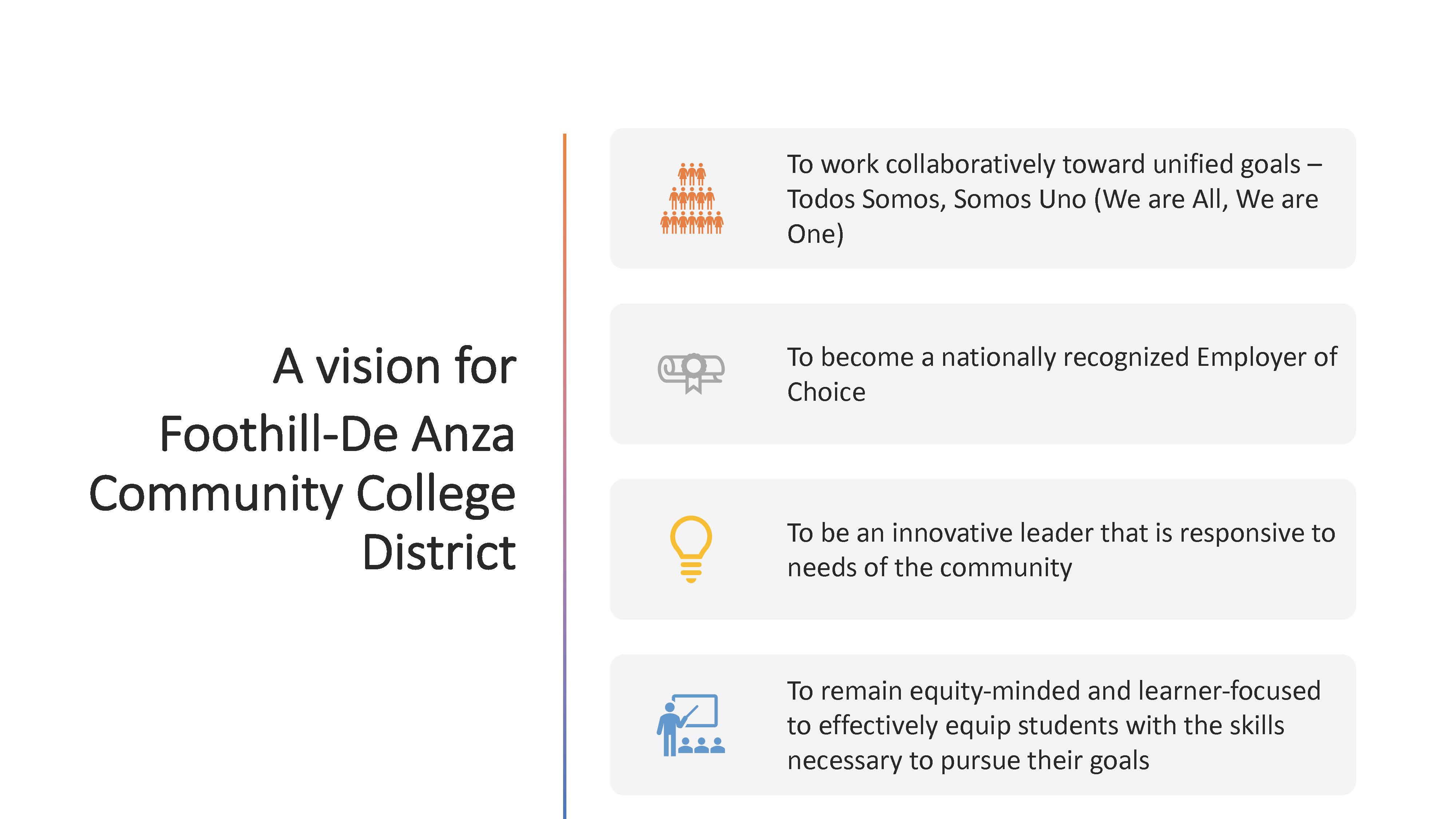
Five Strategic Priorities (Transformational Aims):
Designing the Future of Learning and Society
1. Equity by Design: Empower Every Learner for Impact
Advance justice centered student success by reimagining learning experiences that removes systemic barriers and center possibility, especially for historically marginalized communities. Build pathways where every student becomes not just a graduate, but a changemaker in their family, workforce, and society.
(From achievement gaps to transformation by design.)
2. Learning, Innovation & Liberal Arts Education
Transform how and what we teach by integrating liberal arts education, critical thinking, civic engagement, and career-aligned learning that prepares students for a complex world. Strengthen transfer pathways alongside workforce preparation to ensure students are equipped for further education, meaningful careers, and active civic participation.
(Preparing whole humans to navigate an increasingly complex world.)
3. Digital Transformation & AI Readiness: Build a Human-Centered Tech Future
Equip our institutions, faculty, and students to lead, not just adapt to, the digital frontier ethically and responsibly. Through a unified, equitable tech infrastructure, infuse our culture with the tools, mindsets, and systems needed to thrive in an age of AI.
(Not just future-proof, future-making.)
4. Career Pathways & Economic Opportunities
Create the opportunity for every student to be on a career pathway that leads to a family-sustaining livelihood and economic mobility. Build bridges in higher education between learners and employers that are rooted in equity, relevance, and regional transformation.
(Transforming student success into economic vitality.)
5. Global Citizenship & Civic Innovation: Educate for a Borderless World
Prepare learners to thrive as ethical, digitally fluent, globally minded, and civically engaged citizens. In a time of climate crisis and geopolitical complexity, infuse curricula with global competence, ethical digital fluency, and participatory democracy.
(Because the future belongs to those who can connect across cultures, sectors, and systems.)
Five Foundational Practices:
Building the Infrastructure for a Future Ready Institution
Central to advancing these five priorities are the District’s Foundational Practices, which serve as the essential enablers of this work. These practices, grounded in trust, equity, collaboration, accountability, and continuous learning, are not assumptions. They must be intentionally cultivated, consistently practiced, and actively nurtured across the district to ensure meaningful and sustainable progress.
1. Empowered Governance and Institutional Agility
Cultivate a culture of inquiry, shared leadership, and adaptive governance that puts data to work for justice and progress.
Equip every level of the organization from faculty to frontline teamswith the tools, voice, and trust to co-create equity-centered change.
(From governance as compliance to governance as a catalyst.)
2. Strategic Finance and Talent Innovation
Secure long-term resiliency through bold financial stewardship and human capital strategy. Rethink budgeting, Human Resources, technology, facilities, and resource development as integrated levers for innovation, equity, and mission-aligned growth.
(Fuel the future with smart investments and inspired people.)
3. Partnerships for Impact
Build dynamic ecosystems of partnership across industry, education, government, and community. Move beyond transactional collaboration to shared purpose, expanding opportunity for learners, accelerating workforce transformation, and anchoring regional resilience.
(From partnerships of convenience to coalitions of consequence.)
4. Sustainability and Resilience as Core Design Principles
Infuse climate justice, institutional adaptability, and systems thinking into every plan, policy, and project. Prepare the district not only to withstand disruption but to lead through it, modeling stewardship of planet, people, and purpose.
(Adapt to disruption. Design for durability. Lead for the long-term.)
5. Culture of Trust, Inclusion, and Courageous Engagement
Foster a districtwide culture where trust, belonging, and courageous dialogue are foundational to learning and leadership.
Build policies, professional development, student development and Human Resources systems that affirm dignity, invite challenge, and unlock the full potential of every student and employee.
(Well-being is not just a benefit. It is a shared responsibility for a thriving institution.)